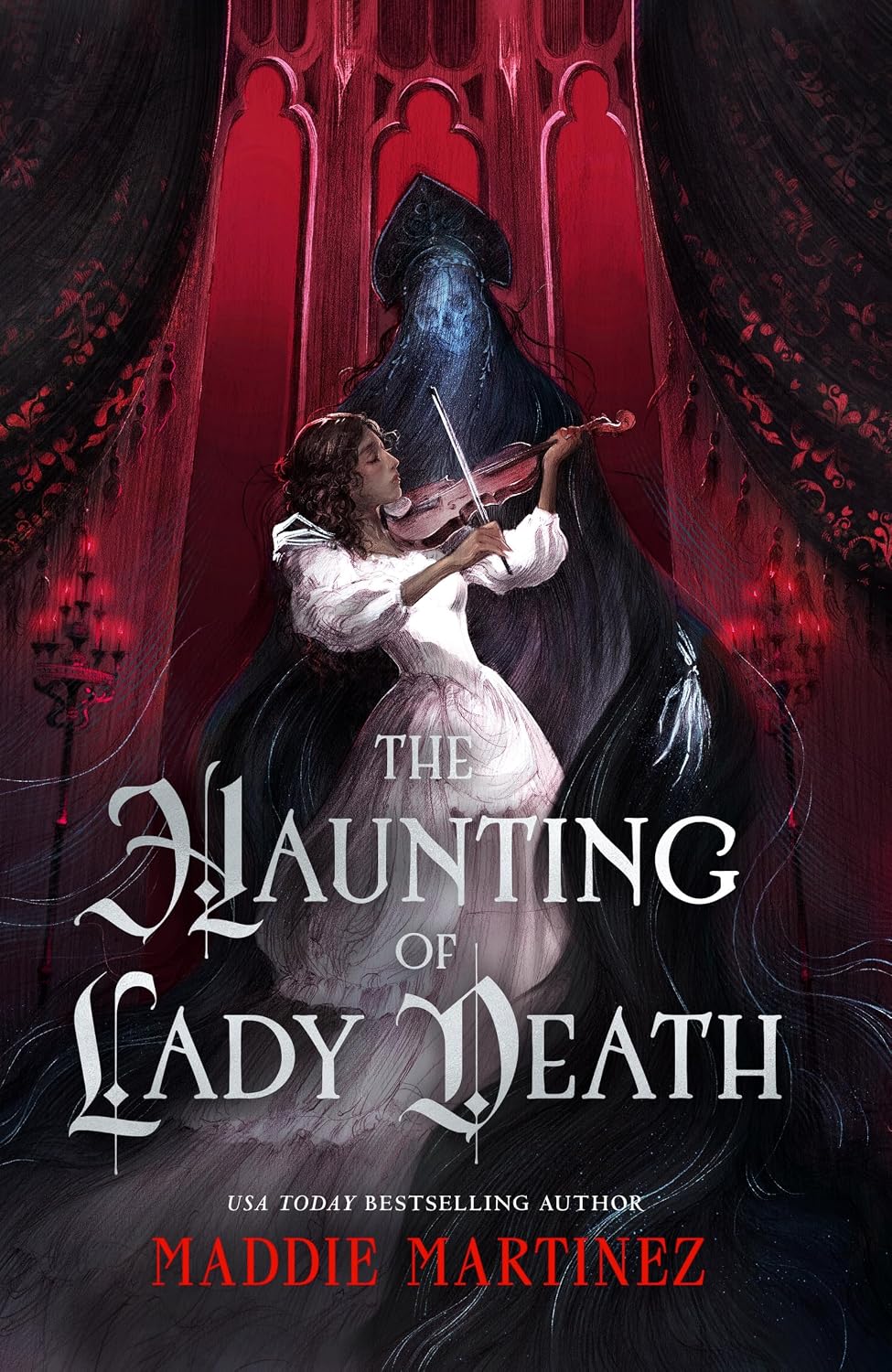
“See the world-famous Larzeg Symphony Orchestra, led by our Perła, Kasia Kalahora…of a deal with Death”.
Picture the hyperpop-rock powerhouse Chrissy Chlapecka’s ‘Aria’ music video crossed with the film Meet Joe Black. That’s the second novel written by queer novelist Maddie Martinez.
The Haunting of Lady Death includes a deal between an ambitious girl and her monstrous, fatal inamorata in her latest book, The Haunting of Lady Death, combining classic sapphic literature with The Phantom of the Opera. The personification of death herself promises violinist Kasia the opportunity to become the ‘Perła’, the leader and face of the orchestra, if she gives death her companionship. Surely, this should not end well… right?
Meeting during a Titanic-esque almost-suicide scene, the two behave as though they are destitute lovers. Death had been listening to our protagonist, Kasia, play her violin for a long time, telling the girl, “Being Death is lonely and endless, Kasia, and you are so very alive when you play.” Ironic, isn’t it?
Kasia embodies passion, talent, and a raging ambition for the role of Perła from the very first page. Her dream is to become a Perła and gain the status and recognition that accompanies the role. Living in a smoggy, cold town, Kasia has little to be joyful about in life. While The Phantom of the Opera’s Christine Daae is often held back by her own grief, Martinez’ retelling of the classic story emphasizes social inequality from the start: Kasia is not allowed to audition because of her darker skin, Azjarian identity and status as an immigrant, and systemic class barriers that gatekeep artistic circles.
The town called Larzeg emphasizes Kasia’s discontent and lack of hope for the future, as well as her lower socioeconomic class. Her past has not served her well, with her father, her violin teacher, and her favorite and only caretaker, dying just before we meet her. As his dying wish, she promised him she would become Perła when the opportunity came. The promise haunts her, literally, leading her to go even further than a simple audition for the role. Death sees her as an even more vulnerable (and by those means, perfect) target for Death’s proposal. The eventual, dangerous relationship with Lady Death begins at first sight. With perilous promises involving a ring and a pomegranate, Death is a seductress from the second she appears. Think about it: why else would someone make a deal with the devil?
Not many people would make a life-altering pact with a deadly figure, but if there’s one thing to learn from her writing, Martinez herself might. As in her debut novel, The Maiden and her Monster, which was based on the Jewish myth of golem, there is hinting at a sapphic relationship flourishing, yet queerness, while an essential part of this novel, is not the main plot point. From a queer YA connoisseur, this is a breath of fresh air. The Maiden and her Monster sparked debate, gained worldwide recognition and praise, and gained a spot on USA Today’s bestsellers list. This one deserves similar acclaim. In both of her works, sapphic relationships between good and (supposed) evil are a byproduct of the protagonist’s mission. Martinez seamlessly weaves this dynamic into Kasia’s devotion to becoming Perła, and Lady Death’s unique power contrasts well with the power-hungry protagonist–although it’s not so much power that she’s after, but her idea of success.
With entirely fantastical towns, titles, and names resembling Slavic folklore, Martinez creates a comprehensive alternate world for Kasia and Lady Death to begin their affair. There are Azjarians, the minorities and Azjan as their language, Plimish, the shared language of all the land, and the Ludi Quarter, the ethnio-religious region they all inhabit. These mythological titles only fantasize the world, while simultaneously connecting both her debut novel and her newest, with their shared fantastical elements.
What a complex character is the personified Death, with power at her disposal and the thirst for lively connection, Lady Death is painted as not so much a devil or monstrous figure, but a person who was forced to live out eternity as Death. Transitioned from a representation of the cycle of life, she is also connected to winter and isolation, able to make rebirth possible without ever getting to experience life herself. The Haunting of Lady Death is an enthralling, eloquently told story of obsession, a rags-to-riches pipeline, and selfish desires fueled by the flames of romance. If you like gothic literature, lesbians, and Slavic folklore, you will love this book.
Nikita is a writer from Brooklyn, New York, currently living in Pennsylvania. She loves all things fiction, music, and Oscar Wilde. She currently does journalism work for the Giancarlo DiTrapano Foundation for the Arts, interviewing the most experienced writers and artists who attended the 2-week writing residencies dedicated to practicing their craft. She is currently writing her debut novel, focusing on drama and comedy, as well as a mystery novel. Additionally, she is working on a book review for the New Orleans Review.